Our Software, a Hundred Problems Solved: Why Integration Is the Future

In today’s fast-moving business world, using ten different apps for ten different problems isn’t innovation — it’s chaos. One platform for sales, another for inventory, a third for communication, and a fourth for analytics. Before you know it, your team is spending more time switching between tools than actually getting work done. This fragmentation doesn’t just waste time; it creates confusion, data silos, and inefficiencies that slow down growth.

Most businesses start small, relying on basic tools like Excel sheets or messaging apps to manage operations. But as they scale, these disconnected systems become a burden. Data gets lost, reports contradict each other, and teams waste hours on manual updates. When your tools don’t talk to each other, your business loses clarity — and efficiency.

This is where integrated business software becomes a game changer. Imagine logging into one platform and having access to everything — sales, inventory, billing, finance, and performance insights — all connected in real time. Integration eliminates duplication, reduces human error, and gives you a unified view of your operations. Instead of piecing together fragmented data, you get complete visibility and control from a single dashboard.

Integration also lays the foundation for AI-powered automation. When your data is centralized, artificial intelligence can easily analyze patterns, predict demand, and recommend smarter decisions. Whether it’s optimizing stock levels, identifying high-value customers, or forecasting revenue, AI thrives on integrated data. In a world where speed and personalization define success, integrated software helps businesses respond faster, serve customers better, and make data-driven decisions with confidence.

At Lailen, we believe software should solve more than one problem — it should connect them all. We build systems that evolve with your business, making it easier to scale, automate, and innovate without losing control or visibility.

Integration isn’t just a trend; it’s the future of digital transformation. Businesses that adopt all-in-one, AI-powered platforms today will lead the market tomorrow. Because when everything connects — everything works better.

 Mizoram — The Hidden Gem of Northeast India

Tucked away in the rolling hills of Northeast India, Mizoram remains one of the country’s best-kept secrets. With its mist-covered mountains, emerald valleys, and the warmest smiles you’ll ever encounter, this small yet stunning state offers everything a traveller dreams of natural beauty, vibrant culture, and peace far from the chaos of city life.

 A Land of Blue Hills and Endless Green

Mizoram literally means “Land of the Hill People”, and true to its name, the landscape is a mesmerizing blend of high ridges, deep valleys, and cascading waterfalls. Whether it’s watching the sun rise over the Phawngpui Peak (Blue Mountain) — the highest point in Mizoram — or soaking in the breathtaking views of Reiek Tlang, the hills seem to whisper stories of serenity.

The drive through Mizoram is an experience in itself. Every turn opens to panoramic views of lush forests and tiny villages perched on hilltops, often surrounded by clouds so close you could almost touch them.

Nature and Adventure Hand in Hand

For nature lovers, Mizoram is paradise. The Vantawng Falls, the state’s highest waterfall, is a sight to behold as it plunges gracefully amid dense greenery. The Tam Dil and Rungdil Lakes are perfect for picnics, boating, or simply sitting by the water and letting time slow down.

Adventure seekers can trek through untouched forests, go caving at Pukzing Cave or Lamsial Puk, or explore the beautiful Dampa Tiger Reserve. Unlike crowded tourist destinations, Mizoram’s wilderness still feels raw, pristine, and deeply connected to nature.

 Where Culture Breathes Through Every Song and Smile

What truly makes Mizoram special is its people. The Mizo community is known for their kindness, cleanliness, and deep sense of community. Visit during Chapchar Kut or Mim Kut, and you’ll witness traditional dances, colorful attire, and soulful music that bring the hills alive.

Every village has its own rhythm  bamboo houses, handwoven textiles, and melodious singing echoing from the churches on Sunday mornings. For travelers, it’s a rare window into a world where modern life and tradition coexist beautifully.

 Cozy Cafés, Local Flavors, and Simple Joys

Aizawl, the capital city, is a hill town like no other. With winding streets, pretty viewpoints, and a rising café culture, it’s the perfect blend of urban charm and local warmth. Try a hot cup of tea with a  cozy café overlooking the valley you’ll understand why people call Mizoram “peace in the form of a place.”

 Why Mizoram Should Be on Your Travel List

  • It’s safe, peaceful, and welcoming — ideal for solo travelers, couples, and families.
  • It’s untouched and authentic, far from the over-touristed chaos.
  • You’ll experience a community that truly values harmony, cleanliness, and respect.
  • And most of all, you’ll leave with a calm heart and stories you’ll want to tell forever.

 Final Thoughts

Mizoram isn’t just a place you visit; it’s a place you feel. From misty mornings in Aizawl to the laughter of locals in remote villages, every moment here is a gentle reminder of life’s simple beauty.

If you’re looking for a destination that’s peaceful yet full of soul, offbeat yet breathtakingly beautiful  Mizoram is calling.

 About Lailen Consulting Private Limited

At Lailen Consulting Private Limited, we take pride in telling stories that matter — stories of innovation, community, and the spirit of Mizoram. From developing homegrown tech solutions like the Sulhnu App that helped thousands during the pandemic, to promoting the people and places that make this land so special, we believe in giving back to the community that inspires us every day.

Discover more about our work, projects, and vision at Lailen Consulting Private Limited and join us in building a brighter, connected Mizoram.

How a Small IT Firm from Mizoram Built an App That Protected Thousands During the Pandemic

When the COVID-19 pandemic struck, like everyone else, we were faced with an enormous challenge how to keep people safe while still staying connected. In Mizoram, where life revolves around community gatherings, church services, and office meetings, it suddenly became risky to do the simplest things. We realized that contact tracing and visitor control had become urgent needs.

That’s when we at Lailen Consulting Private Limited, a small IT firm based in Mizoram, stepped in and decided to create the Sulhnu App a simple, contactless way to replace manual visitor sign-in sheets. The idea came from a very human place: we wanted to protect our people.

During those uncertain days, even sharing a pen or touching a visitor book could feel unsafe. We wanted to offer something more than just convenience we wanted to offer trust, safety, and peace of mind.

What made Sulhnu truly special for us wasn’t just the technology behind it; it was the heart that went into it. We didn’t build it for fame or profit. We built it out of love for our community as our way of giving back during one of Mizoram’s toughest times. Every line of code we wrote carried that purpose to make life easier, safer, and more connected for everyone around us.

Soon, Sulhnu was being used by over 96,000 people across the state in offices, churches, shops, community gatherings, and even homes. Seeing people scan a QR code instead of signing a sheet became a quiet symbol of collective care. It reminded us that technology can serve as a bridge of compassion, not just efficiency.

To strengthen trust, we signed an MoU with the Government of Mizoram, ensuring that all personal data collected would remain protected and never be misused. We made sure that every piece of information was encrypted and handled responsibly because privacy and transparency mattered deeply to us.

For me, and for all of us at Lailen, Sulhnu became more than just an app. It became a symbol of unity and resilience. It proved that even in the darkest moments, hope can be built with code, and compassion can drive innovation.

In a world often driven by profit, Sulhnu stands as our digital gift to Mizoram built with purpose, shaped by empathy, and powered by our love for the people we call home

 Is Marketing as Exciting as Emily in Paris?

If Emily in Paris made you think marketing is all champagne, hashtags, and perfect lighting think again. The real world isn’t quite that glamorous, but it’s just as thrilling in its own way.

The Glam vs. The Grind

Emily lands dream clients overnight and turns every idea into a viral hit. In reality, marketing is equal parts creativity, research, and strategy. It’s testing 10 versions of an ad, analysing audience data, and learning why people click or don’t.

The real magic isn’t in selfies and slogans, but in understanding human behaviour and turning insights into impact.

The Real Excitement

Sure, there are late nights, endless edits, and client feedback loops. But there’s also that creative high when a new idea clicks, a campaign goes live, and people actually respond. That’s the true “Emily moment.”

So, Is It as Exciting?

Maybe not in the cinematic, Parisian way.
But marketing is real, fast, and constantly evolving where creativity meets psychology and ideas shape culture.

No perfect lighting, no background music. Just strategy, coffee, and connection.
And honestly? That’s far more exciting.

Why Marketing Guys & IT Guys Will Never Choose the Same Woman

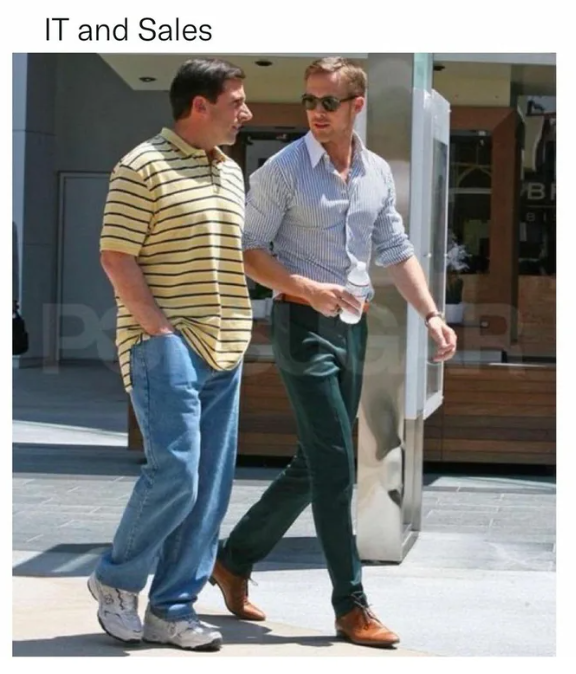
You know that famous meme from Crazy, Stupid, Love — Ryan Gosling (the “Marketing Guy”) standing sharp in a perfectly tailored suit beside Steve Carell (the “IT Guy”) in his oversized yellow polo, dad jeans, and well-worn New Balance sneakers that shout comfort over style.
Every time it pops up, I laugh — not just because it’s funny, but because there’s some truth buried in it. Having worked in an IT company as a marketing guy myself, I’ve seen the contrast up close. And honestly, the relationship between marketing folks and IT folks might be one of the most fascinating workplace dynamics ever.

The Corporate Odd Couple
In the corporate world, you’re surrounded by people you’d probably never meet otherwise — people with completely different qualifications, hobbies, and even dreams. Yet somehow, we make it work. We collaborate, we argue, we learn to understand one another.
And at the opposite ends of this corporate ecosystem are the Marketing Guys and the IT Guys.

The Look: Pinterest vs. Stack Overflow
The meme works because it’s visually accurate.
Marketing people live and breathe presentation. We represent the company — pitching to clients, closing deals, creating first impressions that last. Our wardrobe isn’t just clothing; it’s strategy. The shirts fit right, the shoes could sell themselves, and even the perfume is part of the branding.
We scroll through Pinterest, not Stack Overflow, for inspiration. We carry iPhones not because we’re Apple fanboys or fangirls, but because that polished logo communicates premium. A marketing guy can walk into a wedding uninvited and blend right in — effortlessly.
Then you have the IT team. Their style philosophy is simple: Comfort is king. When you sit in front of a screen for ten hours straight, no one’s judging your hoodie. So it’s graphic tees, joggers, worn-in sneakers, and a hoodie for when the office AC gets aggressive.
That doesn’t mean they lack style — it’s just street style. And when it comes to gadgets, they want control, not polish. They prefer Android — not because it’s cheaper, but because it lets them tweak every pixel to their will. Forget weddings — they’d blend in perfectly at a college fest or gaming convention.

How We Buy Things (and Why It Says Everything)
Take something as simple as buying earphones.
The marketing guy walks into a store and goes straight for what’s trending — Apple, Sony, Beats, Marshall — whatever looks premium and fits the budget.
The IT guy? He’s deep in audiophile forums reading about IEMs (In-Ear Monitors) most people have never heard of. He doesn’t care about brand names or influencer reviews. He wants specs — impedance, frequency response, driver configuration, and decibel output at 1kHz.
It’s the perfect metaphor: marketing buys emotion; IT buys performance.

The Way We Think

Our professions shape our minds.
In the IT world, everything is binary — true or false, one or zero. Code either runs or it crashes. So their thinking becomes structured and precise. There’s no “maybe” or “sort of.” Try persuading an IT guy with emotion and he’ll smile politely while mentally filing you under non-logical human.
Marketing, on the other hand, thrives in the gray areas. We deal in perception, persuasion, and possibility. We live in “it depends.” We see nuance where IT sees syntax errors.

And Then Comes the Woman Question
Now, back to the headline.
When it comes to relationships, marketers and IT guys approach love exactly how they approach work.
Marketers love to test before they buy. We run free trials, explore options, and make sure we’ve experienced every feature before committing. It’s how we’re wired — test, analyze, decide.
IT guys, however, don’t run beta versions of relationships. They take their time, think deeply, and once they commit, that’s it. Most developer friends I know don’t have multiple exes. They don’t compare, they don’t chase trends, and they certainly don’t scroll for “upgrades.” Once they choose, they’re in it for life.
Maybe that’s why their relationships last longer — they don’t even notice if the grass is greener on the other side. In fact, they barely acknowledge there is another side.

Two Worlds, One Mission
Marketers chase trends; IT folks chase logic. Marketers dream in color; IT works in code. One polishes the story, the other builds the system behind it.
And yet, when these two worlds collide under one roof, magic happens. The storyteller meets the problem-solver. The vision meets the execution.
It’s proof that in the end, it doesn’t matter how differently we think, dress, or choose our women — because together, we make things work that neither side could build alone.

Eng nge software?

Kan hriat lutuk loh lai pawhin software kan tih hi kan ni tin hun hmannaah a tel zel tawh a, kan khawl hman, kan phone leh computer te’n an nih tur ang an nih theih chhan hi a ni pawh a tih theih ang. Hna leh thil eng pawh awlsam leh rang zawka min tihtir theitu a ni a, zing thawh hma nana alarm kan kam te, thiante biak nan phone kan hman theihna te, ral chah dawr kan hman theihna te, heng zawng zawng tih theih nan hian software hi a bulpui ber a ni. Software kan hman thinte tel lo chuan kan khawsak phung a buai pha tawh a ni.

Ni tina kan hman a ni satliah lo a, khawvela danglamna thlentu lian tak a ni. Vanthengreng lam kan hriat loh zir belh zel nan te, khawl kaihhnawiha hmasawnna kan neih nan te, energy siam chhuah kawnga kan felfai zawk nan te, kan hmu thei kher lo a nih pawhin, software hian heng zawng zawng bakah, kan tunlai khawvel inlumlet dan hi a hril vek tawh a ni. Software hi awm lo ta se, kan nun hi tun ai hian a harsain, kan nun hona kawngah inzawmna tha kan nei thei kher awm lo e.

Kan ni tin hun hmannaa software pawimawhnate:

– Thil lei turin dawrah i kal a, pawisa i ah remchan mai loh avangin internet kaltlanga i bank account i thlunzawmna application; Google Pay, Paytm emaw, a dangte pawh hmangin pawisa i pe thei a ni. Heng application hi software avanga hman theih a ni a, awlsam, rang leh him taka pawisa i pek theihna hmanrua an lo ni ta a ni.


– Online-a thlawhtheihna ticket i lei dawnin software pawimawhna a lo awm leh a, ticket man pek mai bakah, ticket confirm-na atante software chu hman tangkai a ni leh a ni.


– Social media kan tih; Facebook, Instagram, Whatsapp, Telegram leh a dang tam tak pawh a awm ang. Heng hlawhtlin theihna leh kan hman theih chhan chu software hi a ni a, a tel lo chuan kan inbiakpawhna hmanrua zawng zawng hi hman theih a ni lo a ni.

– Thlalak kan edit leh kan siam that hian software bawk kan hmang a, software tel lo chuan thlalak edit leh siam that hi thil theih a ni lo.

– Youtube leh smart TV kan en a, en tur kan neih theih nan hian software bawk hman a ni. Software tel lo chuan heng kaltlang hian en tur a awm ngawt lo a, tunlaia kan inawm tleina pawimawh tak zingah software hian hnathawh pawimawh tak a nei a ni.

– Music leh movie industry kan tihahte hian software hi a pawimawh zual em em a, rimawi emaw, movie chhuah tur siam nan leh rem that nan software kan mamawh a ni.

– Tunlai khawvela kan mamawh tam tak, a te ber atanga a lian ber thlenga an hnathawh leh kalphungah, an innghahna pawimawh tak chu software hi a ni. Thil siam chhuahna hmunah awlsam leh tha zawk, felfai leh rang zawka engkim kalpui a nih theih nan a pawimawh em em a ni.

– Damlo dinhmun vawn nan te, appointment siam nan te, khawl hmanga inenkawl pek nan te, ral khat atanga mithiam zawk rawn an nih theih nan te, natna neite hriselna en zui nan bakah, mi zawng zawngin inenkawlna an dawn theih nan te software hian kawng a su thei hle.

– Video conference neih theih nana application kan hman te, Learning Management System (LMS) leh zirna kawng hawn nan pawh software hi hman a ni zel a, a hmuna awm kher lo pawha kawng hawngtu a ni chho zel a ni.

– GPS bakah Google map leh Uber te pawhin chawplehchilha kan awmna leh a chhehvel min kawh hmuh theih nan software an mamawh a, khawi hmunah pawh kal dawn ila kawng awm dan leh kan kalna tur leh awmna dinhmun chiang takin min hrilh thei a ni.